September 23 to 26, 2007
Bulletin from Lhasa

Thoughts on the Porcelain and the Bamboo Throne
I spoke of anorexia
prematurely. One of us was soon to be stricken with a severe case of the
no-eats. It was Gary,
of all people. Mr. Deny-Myself-Nothing, my burger-a-day boy, who leaves no
scrap of bread unbuttered.
Whether this was caused by food
poisoning (Gary’s vote) or altitude sickness--the consensus of the brigade of doctors
who've so far treated him, plus our three local guides—each quite familiar
with this syndrome—plus amply confirmed and blessed by the
all-knowing internet, the result is that Gary has now lost even
more than the 10 pounds he predicted as he gorged his way through a host of New
York restaurants before we left.
(Some people will do anything
to be right.)
In all seriousness, almost as
soon as we hit the rarefied air of Lhasa (elevation 3700 meters, some 12,000
feet) he became quite ill—weak, exhausted, had great difficulty breathing (we
all experienced some of this, especially walking up uncountable sets of steep
steps to Tibetan monasteries and old Dalai Lama palaces.) In a further
ramification, even the smell of food sickened him and he was unable to keep
even small morsels of food down. The labored breathing and constant bouts of
hiccups made his chest and ribcage sore and breathing even more difficult.
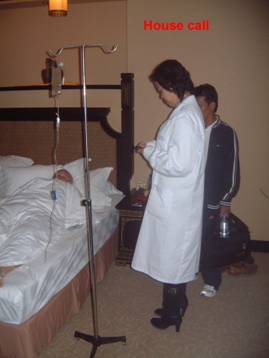
We had hotel-room visits (they
still make house-calls here) from doctors three nights in a row, in two
different cities, and several glucose transfusions. In addition to Gary’s continuing
pain and discomfort, let me tell you it is quite scary (even considering our
semi-nomadic lifestyle in Caribbean islands with questionable medical
facilities) to be stuck somewhere with an unfamiliar ailment, dependent on
hotel-clinic doctors who speak no English, whose diplomas are not displayed
prominently, who appear to be arguing vigorously among themselves about your
diagnosis, who look 15 years old and/or wear stylish high-heeled boots. None of
this inspires confidence in their proficiency.
In any event, in a first for
our 30-odd-year relationship, I actually found myself first saying, and later
begging, “Gary,
you must eat something!”
A word about
Chinese “arguing.” The Mandarin language is shrill and guttural. People
speak very loud, even when they’re standing face-to-face. Naturally we
understand nothing. While they grunt, shout, screech and yammer at each other
with great gusto we’re always expecting a fistfight to break out. But they’re
often only saying good morning to each other and after they finish their
introductory shrieks, we’re surprised when they proceed to hug each other.
(Actually, they’re more likely to shake hands enthusiastically after such an
exchange. The Chinese are far more reticent and much less ebullient than we are
and they continually express surprise about how outgoing we Americans are.)
I see I’ve left
Gary in his sickbed,
shrinking away to a mere shadow of himself. Bottom
line: he missed most of Lhasa
and we expected he’d revive as we came down from those heights. It’s now
several days later, several thousand feet lower yet he’s just beginning to feel
better. We expect him to continue rallying but it was frightening, plus a real
downer, not to have him his usual sunny, punny self. Several times the three of
us considered ditching the itinerary and flying him to Shanghai for less provincial treatment.
We now plan on bringing him to
a Chinese herbalist to find a remedy for his sore esophagus and painful touch
of reflux. (One of the hotel doctors did produce two vials of vile-looking
liquid that cured his hiccups mid-swallow. Would that she’d
left us with more of this Chinese magic. Better yet, would that I could
patent and market it!)
Porcelain throne, Tibetan-style
As long as we’re bringing up
recent China
conversations, let me bring you all up to date on toileting conditions in this
region. On the first day Gary
stayed back in the hotel and had plenty of time to think. Before he truly
descended (if this is not an oxymoron) into altitude sickness, he wrote this
about the innovative design of Tibetan toilets.
“From the outside the Tibetan toilet looks
very much like our much frequented Western-style, white porcelain toilet.
But the genius lies inside. On our toilets
the back wall is almost vertical with the water puddle below, allowing the
insult, if you will, to make an audible splash. Clearly this splash is
objectionable to the Tibetans.
Their solution and monumental innovation is
to incline the back wall steeply forward, leaving space for only a small puddle.
This allows your insult to slide gently down the back wall and silently enter
the water puddle.
An additional benefit is the huge track your
insult leaves on the back wall. In addition, the flush water comes only from
the bottom, allowing the track to remain until the chambermaid comes to scrape
it off.
As honored guests we are not given any
toilet brushes or other cleaning equipment. So until she shows up, the quality
and consistency of your intestinal contents remain available for viewing, just
like my mother always insisted. (Fast forwarding some 60 years, my wife now is
there for commentary and suggestions for possible dietary modification.”)
Chinese rice paper?
Reading it, I have these ancillary
observations on a related and similarly vital topic: The Chinese invented
paper-making but over the centuries, what with continuous warlord
confrontations, violent emperor unseatings and fierce dynastic takeovers, they
apparently never advanced into toilet paper design. If they had, they’d surely
have come up with the perforation system before we
Westerners. Since they didn’t, this useful enhancement advancement is minimally
available here.
In addition the indigenous toilet paper
quite resembles our crepe paper (perhaps this texture lent itself to early calligraphy)
so that as you pull, and as you encounter no perforations, it begins
stretching.
In any event, tearing off your toilet paper
generally results in a veritable bouquet of unusable streamers hanging off the
roll. The more annoyed you get, the more you pull, the more tattered shreds
you’ve got and suddenly you are very far away from the point at which the roll
becomes full-width again. Working your way back to full-width is tedious and of
course results in a pile of paper on the floor. (Two-ply of course only adds to
the complication.)
Next, the Feng Shui of the toilet
paper holder placement apparently required that they place way behind the
toilet, so you have to spin around to use both hands—one to hold, one to tear.
At about this point the wall phone above the toilet paper holder falls off the
wall.
Even
earlier bamboo models
Still, even this toilet compares favorably
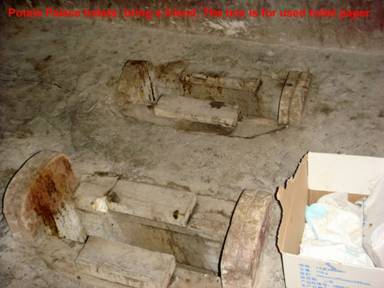
with the Tibetan model I saw (but Gary
missed as he wrote his missive) at the 7th century
Potala Place, which
was the residence of successive Dalai Lamas. So we can only assume that these
holy presences also used the hole you see in the photo below.
And, finally (I’m sure we all hope) on the subject of local toilets, I
have continued practicing my squats and perfecting my aim so that I almost no
longer splash my calves or pee all over my shoes. I had no idea how difficult a
technique this is and so owe apologies to two sons and two husbands, all of
whom I have accused on multiple occasions of being lackadaisical in their aim.
And speaking of husbands, as we progressed
to a lower altitude, Gary began breathing but food continued to be
uninteresting, his chest and stomach were still painful and he was afraid of
throwing up in the van during our various day tours. By last night it was a
full four days and he was now suffering reflux since there was nothing in his
stomach but acid. I agonized about what to do with David and Joan, who have
been incredibly supportive during this time. We returned from dinner. I woke
Gary, told him the three
of us talk about nothing else and he had to start eating something. He relented.
At 11 PM David took off on an emergency rice run
through the old city of Lijiang,
yet another interesting city populated by ethnic minorities, most of them
speaking their own languages. Our hotel is located amid a warren of tiny,
winding cobbled streets, so convoluted our guide has to lead us there. David
wrote home this morning:
“I succeeded [in finding rice] but got totally lost. I
showed the hotel card to about 15 people but it was only in English and
Mandarin. Every single one was smiley and happy to be asked and everyone
pointed straight ahead. Finally a passing seeing-eye yak led me home.”
Gary obediently ate some rice and has started
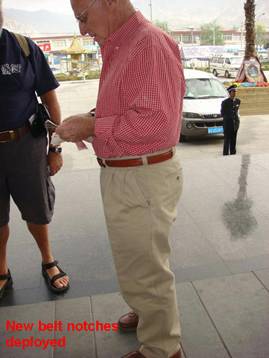
to feel better. I predict the new notches he has been using on his belt will
soon be relics of the past. And, next time we promise to get back to the spectacular
experience of traveling China.
September 28, 2007
Gary is walking,
talking and eating again. The new notches on his belt are still in use.
Louise