October 22, 2007
China Distillation: Getting it right, getting it wrong
In Yunnan
province our Chinese guide was a buck-toothed character who called himself
Crazy Jake. He claimed he’d been a painfully shy boy until he began learning
English from a teacher who got him to project, to be brash and confident,
literally to run up to his dorm rooftop and shout the lessons. To belt it out.
Jake was crazy about English, the person he’d become and his future.
We assumed the teacher was a university professor but he
turned out to be Yi Ling, a successful mass merchandiser of the English
language to Chinese. The lectures were sometimes in-person appearances before
30,000 or so and sometimes mail-order tapes, not always updated. So some of
Jake’s slang was slightly antique. He said things like, “See you later,
alligator…after a while crocodile.” Out loud and proud. We taught him “dude.”
He said his girlfriend was drop-dead gorgeous. We brought
him up to date with “way cool.”
When I took a breath after five breathless weeks of gawking
and tried to distill our impressions of China Jake came to mind. China is
massive, brash and confident, a mega-successful mass merchandiser--yet
Communist. A lot crazy. It is drop-dead gorgeous and whatever it’s doing, it
belts it right out. It is way cool.
Like
Jake, the country it has become was spectacularly unforeseeable, a phoenix that
rose from the ashes of war, famine, poverty, cruel and misguided leadership.
From a historical perspective,
this sophisticated 3,000-year-old society saw frequent and multiple invasions,
internecine warfare, dynastic changes; the infrastructure needed significant
routine maintenance. The most successful dynasties kept up nicely. The
last--Qing (pronounced Ching), which lasted almost 300 years, accomplished
major facelifts, statuary replacements and in general kept up appearances in a
big way--up to the early 20th century. A lot of Qing handiwork was
wiped away by regional warlord squabbles in the ‘20s, a Japanese invasion in
the ‘30s and occupation in the ‘40s, World War II, the ensuing Kuomintang vs.
Communist battles and finally the dramatic devastations of the Cultural
Revolution from 1966-76.
In what may well be the
quintessential examples of colossally ignorant political policy, autocratic abuse
of power and gigantic betrayal of trust, Mao Tse Tung destroyed incalculable
national treasures, including the entire educational system, on a massive and
brutal scale. But subsequent leadership has been exceptionally savvy. Starting
in 1978 an assortment of reformers not only midwifed the rebirth of commerce,
manufacturing and international trade, but also took the country’s grand-scale
natural beauty, its gigantic backlog of man-made constructions, and married
them to the enduring tourist appetite.
While China is
luxuriating in this astounding present and intending an incredible future, the
things it’s getting wrong are significant. They demand, but may not be getting,
serious attention: pollution, peasants, some basic human rights and some basic
human needs.
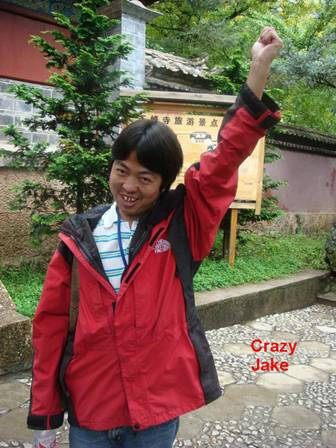
The guides
Crazy Jake took us to the
Stone Drum town. This ancient village is strategically placed on a
comparatively narrow neck of the Yangtze, which made it the scene of numerous
battles through the ages--most recently during Mao’s Long March. The Red Army
escaped the Kuomintang by swimming across the river, buoyed by air-filled
leather pouches lent them by partisan villagers, among them an uncle of Jake’s.
Frequently guides like
Jake became, for us, the physical presence of China’s tumultuous past and its
schizophrenic present. They embodied and explained events we’d read about that
were so diametrically opposed to our political milieu we couldn’t quite grasp
them as real,
Jake could trace his
lineage back 700 years to when his ancestors ruled the nearby and historically
influential Burma Road town of Dali.
They were, for centuries, the kings, or warlords depending on your point of
view. His father was recently the mayor.
Jake felt secure enough in his family’s prominence to quit the Communist
Party.
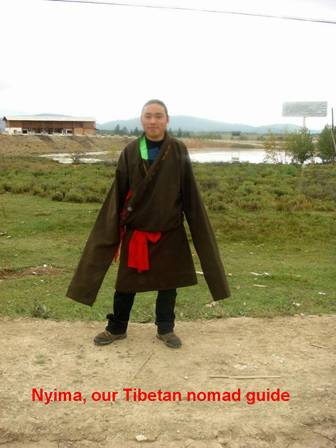
Our Shangri-La guide, the
(quoting Jake) drop-dead-gorgeous Nyima, was one of 11 children of mountain
nomads, His brother, currently imprisoned, is charged with being involved in
whatever tiny amount organized resistance exists to what most Tibetans believe
is the Chinese occupation of their country. His grandfather and great-uncle,
clan leaders, were on the government’s hit list after the Tibet
“liberation.” They fled to the nearby impenetrable mountains, where friends and
compatriots sheltered them
Our
Lhasa guide, Tenzin (pronounced, all too
coincidentally, dungeon) was descended on both parents’ sides from formerly
prominent families: wealthy, educated, traveled, many of them government
officials. Labeled “capitalist roaders,” these were the first targets of the
victorious Communist government. Tenzin’s paternal grandfather also took to the
mountains—with the Dalai Lama, when His Holiness fled Lhasa with a small entourage dressed as
peasants, protected along the way by loyal farmers and Buddhists. Tenzin’s
parents met during the Cultural Revolution, scions of the newly denounced,
ridiculed subclass of forced laborers and field workers the government
relocated to the freezing north. Though they have never regained their
possessions or status, his parents are now retired and permitted to live in
Lhasa.
Few talk openly of
politics or anti-government leanings. This is, after all, a dictatorship. Their
opposition, rage, sadness or helplessness seeped out in conversations during
long van trips. Or after our prolonged probing. One Muslim guide called them
“hot potato” topics, and simply wouldn’t discuss them. For another, the mere
mention of the word “Chinese”—Chinese anything—made his mouth twitch
involuntarily and twist into a miniscule sneer. His every reference to the Han
Chinese majority was accompanied by tiny snarls and brusque dismissal. All of
this occurred only in enclosed vans,,,and only when it was certain the Han
Chinese driver spoke no English.
Only one, one of the
youngest and most optimistic, just recently out of university, was capable of
hissing, “We HATE Chairman Mao!!
And then, “But don’t
repeat that.”
The Tibetans
The minority
peoples—their costumes, their singularity, their existence at all in what we’d
assumed was a monochromatic, monolithic Chinese populace—continued to fascinate
us. The feelings were entirely mutual. Over and over, in Tibet, particularly,
but also in more remote areas where fewer tourists venture, ethnic people and
even some Han Chinese stopped us and asked to take pictures with us. Big, burly David—with his gray beard and
friendly smile—was a particular favorite. They seemed to love being dwarfed by
him. I assumed my own popularity related to the blond hair.
The Tibetans knocked us
out—their gentleness, their cheerfulness in the face of grinding poverty, their
intense family loyalty, devotion and religious passion. Daily, and into her
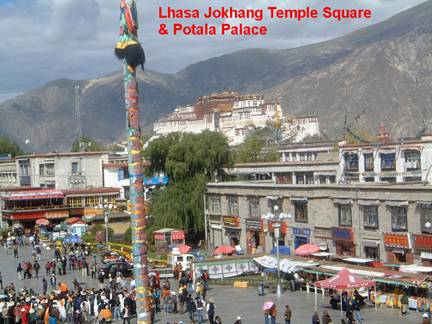
late eighties, Tenzin’s grandmother, pursuing Buddhist practice, circled the
gigantic Potala Palace twice—clockwise, always clockwise—and the most holy
Jokhang Temple, three times, fingering prayer beads with one hand, shaking the
prayer wheel with the other, all the while murmuring chants, reciting sutras. A
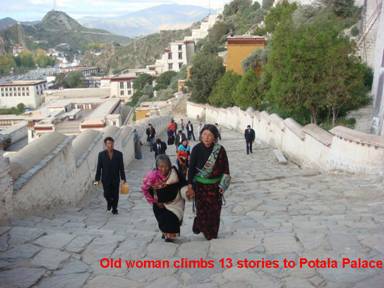
solid five hours a day. We trailed behind countless like her—bent old ladies
you’d bet couldn’t make it across a room--climbing all 13 stories of irregular
stone steps, merely to the threshold of the
Potala Palace.
Numerous other staircases followed inside.
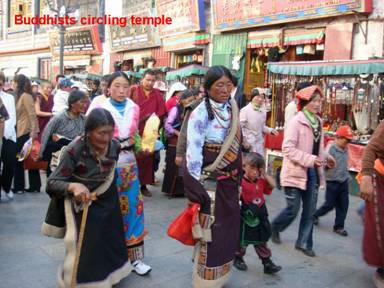
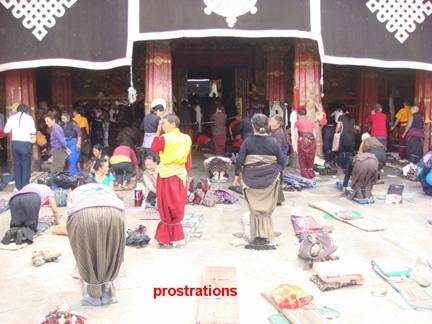
The young and old planted
at temple gates awed us: bowing, praying silently, falling suddenly to the
ground, and completing prostrations, in complex series that seemed to have no
end. Entire families of pilgrims, their worldly possessions on a single wagon,
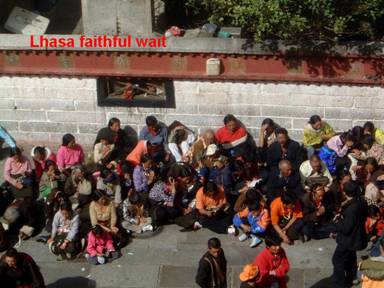
descend the surrounding mountains’ harsh terrain to pray in Lhasa’s sacred Buddhist sites. They wait
outside the Jokhang gates from before sunrise--imagine being turned away from
your most holy place of worship because after noon it becomes “tourists only.”
The Chinese clearly have
the upper hand with these conquered peoples and pockets of ethnicities, many
predating Christ, others Genghis Khan. The official policy is to surround them
with Han Chinese, outnumbering them, making protest and rebellion all but
impossible. Otherwise the government lets them practice their different customs
and religions--even have as many babies as they choose.
The government boasts it
leaves them alone. But also alone to
deal with almost every human want.
We were shocked again and
again to learn that everyone, even the peasants (perhaps especially the
peasants, who have the least), pays for school, for tuition as well as
books. Free medical care doesn’t exist.
People simply die if they can’t pay for the operations or medicines they need.
We could never quite shake our preconceived notion that this
is a Communist country—so why don’t the common people get free medical care?
Why do they have to pay for schools? And even books? With 1.3 billion people,
the answer is the government simply can’t and the rhetoric has apparently long
been overtaken by the reality. The divisions between rich, the striving middle
class and the really, really poor are even more dramatic than in our own
country.
The Tiger
On the other hand, the
opportunity created by the government’s laissez-faire approach to private
business undertakings has created unending opportunity for some to get very
rich. As in free economies everywhere
their wealth trickles down to workers in their own businesses, to the ancillary
enterprises and industries that burgeon from their investments and new
ventures, to architecture, the building trades, upgraded housing and the
improving national infrastructure.
Our friend, Donna, who
volunteered in China for Operation Smile in both 1991 and 2001 says the differences
in peoples’ attitudes during that 10 year period were astounding. From
depressed and hopeless they moved to optimistic and vigorous.
Tiger Lee, our Shanghai host, is one who has benefited
big-time. Tiger’s primary business was and is manufacturing satellite dishes.
Smart, quick, nimble and forward-thinking he’s also moved into an assortment of
satellite-related businesses, into television programming, a QVC-type network
for Chinese-Americans and lately into manufacturing rack steel storage shelving.
After
hosting us at the Formula 1 race, Tiger invited all four of us to the opening
of his newest factory, in Souzhou, near Shanghai. It was slick, immaculate, its
scale and shape vaguely reminiscent of the Lincoln Tunnel. The mornings events
were both ceremonial—long introductions—in Mandarin and English translation--by
factory executives, stuffy speeches by every available (meaning all) local
government officials —as well as festive—floral arrangements tied with “Good
Luck” satin bows, congratulatory words from Mama Li decked out in her tasteful
ruby and diamond “daytime” jewelry, an official blessing from the Feng Shui
master, followed by a ribbon cutting, tree-sized explosions of white sparklers,
which temporarily obliterated the dais, and a 21-gun salute’s worth of
firecrackers outside.


We walked
the factory floor. Machines--operated by uniformed workers--began whirring,
extruding, bending, painting and even stacking the tubular shelving.
By now it was past lunchtime. Knowing a factory smorgasbord wasn’t the Tiger
way, I wasn’t surprised when we were next scooped back into vans and buses—the
four of us and my son Bobby—plus the government officials, board members,Tiger
family, factory management, the Feng Shui master, of course, plus the legion of
Tiger staff who already have full-time jobs but also travel along with Tiger’s
guests—each one smiling, kind, available to heap more food on plates, more wine
or beer down gullets, clunk glasses and exhort us, ”Don’t drink alone.”
We were whisked through the rain to a shopping center, up an
escalator and past a bevy of welcoming red-dressed hostesses into a restaurant
for a congratulatory lunch for 100 or so. A waiting array of cold dishes
greeted us. Despite their names, overall appearance and degrees of sliminess, I
tried them all—more precisely, I tried them before asking what they
were. I took my eating cues in this
arena from my son Bobby, who has long surpassed whatever training I ever gave
him about “trying everything.” Whatever he ate, I ate.
The cold assortment included marinated dates, hacked chicken, edamame, daikon
ribbons, shredded jellyfish (delish!), chicken in soy broth, smoked fish,
seaweed salad and two generic green vegetables.
Faster than we could clear our chopsticks the hot dishes
began arriving. Eventually all available tables surface disappeared; thus
platters were stacked on platters, brick-wall style, so everyone could still
get to the remaining morsels of whatever was below. ‘
The pork, duck and rib dishes were easily identifiable…their
main ingredients anyway; the different and quite divine sauces remain a
mystery.
The other entrees: fried pork belly with broccoli, beef with lotus root, fish
stomach, abalone, tiny morsels of sweet shrimp, baby lobster tails with noodles,
some kind of sliced fish, a whole steamed fish with ginger and scallions, duck
soup with bamboo shoots, sweet rice soup, a vaguely egg-droppy-type soup, fried
rice, steamed rice, pan-fried noodles, steamed Shanghai dumplings, a bok choy
and a cabbage dish. Oh, yes, and tripe with something or other. And, yes, I
tried the tripe. Not bad, but not a keeper…
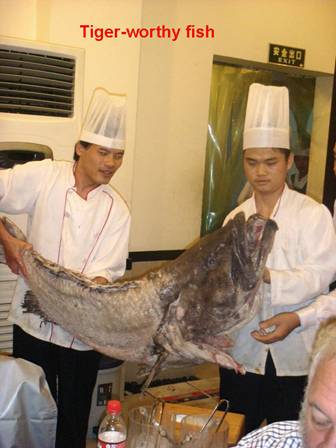
My count is 30 dishes when you deduct the steamed rice,
which really shouldn’t count. Though there may have been a dish of black bean
clams too. This excludes dessert, which the Chinese--even Tiger--are blessedly
lackadaisical about.
We washed all this down with cold Heinekens,
room-temperature red wine, hot tea and ice water (for Gary) A very popular
bottle of was also passed around: clear and 58% percent alcohol, the Chinese
grappa, I guess. Fortunately my Bobby was already far too familiar with
late-night shots of this beverage and so I was spared.
We rolled back into the vans, inched through the
early-evening rush hour Shanghai traffic, arriving back at the Shangri-La at
around 5:30. We were allotted an hour to shower…change…vomit—whatever, as long
as we appeared in the lobby ready to be packed back in the vans and inch
through the Shanghai late-rush hour traffic. We also had to re-charge our
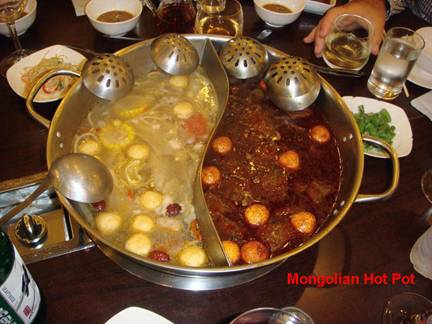
appetites, make them ready for dipping into Mongolian Hot Pot. At 7:30 PM, we were back at tables for 10,
chopsticks in one hand, beverage-of-choice in the other. Don’t drink alone.
The friend?
Also
after Formula 1, a cruiser who had been receiving our China emails, ripped into
us in a return email, suggesting we get out and see the “real China” instead of
bustling about with the wealthy ½ to 1 percent of Chinese people, watching them
throw money round. I’m paraphrasing pretty closely here.
“It’s like
going to Disneyland for the Orient experience,” he wrote.
The “real” Chinese, he said, with average monthly incomes of
2000 yuan ($240), and half that for farmers or peasants, are “kind and
generous. Generosity is not giving a lot--it's giving when you have nothing.”
He met these real Chinese during a 2 ½ month visit to China, when many invited
him and his wife, perfect strangers, into their simple homes, offering them
sleeping room on the floor.
These authentic Chinese, “who work harder than you or I ever
have” revere worthwhile values like “honor, honesty, family.”
Rather than experience “America in China, decadence Las
Vegas style,” he encouraged us to get off our tour, into the streets and find
the true China. “Eat congee, Dimsom [sic] and dumplings till you get stuffed,
which won’t you cost more than $10.”
“Over the top decadence is an American thing, not a Chinese
thing,” he went on. “China is simply
learning what we as Americans know all to well, we all will sell out for the
right price. Culture is lost to individualism and individualism is the the
basis of narcissism.
See it before it's gone.”
Among other things, he was surely objecting to the Tiger
opulence. (Tiger may, in fact, not be real Chinese, since he is
Taiwanese.)
Though this advice was “offered with love” it sure felt like
a slap in the face.
So I slapped back.
I sat down and wrote,
“Dear ‘Shall-Remain Nameless:’
We'd like to suggest that you get off your high horse...or mast...or
whatever you're on.
We're in China right now and when you return in 2009 you may
find it very different from the way it was. There are probably 200 different
Chinas but there certainly are at least three...rich, poor and striving--and
all three are into the quality of their relationships. What you wrote felt a
lot preachy and from our vantage point, whether on the hot streets or in a
cushy hotel, we see that China is as--or more--capitalistic than most
places we have ever been. It has come as a huge shock to us. If there's a
‘real’ China as you suggest, we'd like to see it step up to the plate.
Everyone we have met is scrambling not just to get ahead but as far
ahead as possible. Maybe that has to do with catching up and passing
the rest of the world and/or maybe everyone wants to get as far away from Mao,
the Cultural Revolution, deprivation, corrupt officials, the Communist party
and phony ideology as possible.
In addition, we believe, materialism, however sublimated in the
form of emperor-, jade- bronze- silk- or porcelain-worship, has always run
very deep in this society. Maybe you've never noticed but the other category
Chinese people ALWAYS pray for--in addition to health, long life, good
harvests, enough rain, not too much wind--as in no typhoon, no tidal
wave (not so different from us mariners)--is wealth. Just today our
Chinese guide told us ‘to show the value of a man he should be well dressed; to
show the value of a Buddha, it should be gilded.’
For the
first time in a very long time, people see some real opportunity. They
know they need to take care of themselves (and their families and loved ones)
because there is no free medical care or really even free education.
They have to do it all for themselves.
Kindness and goodness actually do cross all financial and social lines.
The honor, decency, honesty and family you mention are not restricted to a
single class (however low) or pocketbook (however empty.)
Individualism may breed narcissism but it also breeds creativity.
Mao-ism was the perfect example of when you lose all sense of
individualism.
Tiger, whatever you may have concluded, takes phenomenal care not only
of strangers like us but of his own--and that goes for his mother,
his 3 brothers, 2 half-brothers, his sister, his former wives, his
2-year-old son, his girlfriend, the many middle managers who work tirelessly at
whatever he asks them to do--whether in Taiwan, in Shanghai, in Suzhou, in
Beijing or in LA.
And also of his thousands of factory employees wherever they work. Plus,
every bellhop, waiter, driver or chambermaid who crosses his
wake. When one of his managers, in Denver, needed a small tumor removed
Tiger not only arranged and paid for the best possible surgery
and after-care in LA, but also flew there himself with 4 key
employees and stayed for 3 weeks to make sure the process went
smoothly. Plus insisted on being at the man's bedside at midnight when he
awoke in intensive care.
We are enjoying every facet of our trip--but it's true we haven't run
into too many poor peasants. Few peasants but plenty of nomads, farmers, office
workers, unhappy Tibetans, dissident Muslims and, yes, a lot of rich or
aspiring to-be-rich people too. They have all been unfailingly caring,
good-natured and frequently religious in the highest sense of
the word.
Whatever you wrote may have been offered with love but it sure
didn't come across that way. Clearly our emails are disturbing to you,
so we've taken you off the list.
Mei wenti—no problem.”
“Shall-Remain-Nameless” recanted the next day, writing “I rescind
and apologize.” And we accepted.
The peasants
But in some sense he was correct. There was still more of China to see.
Tourists, and maybe especially tourists in China, where there is just so much
to see, are insulated from the poor and ugly.
Nearing the end of our itinerary, after all the big cities,
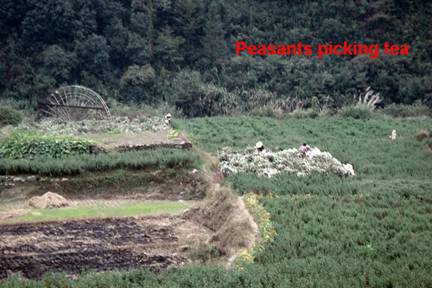
we drove much of agricultural Anhui province, thickly spread with uncountable
terraced rice and green tea fields. Amid them a patchwork of white
chrysanthemum fields, where small clusters of peasants in coolie hats toiled--tiny,
hunched, and bearing straw baskets on their backs--picking white blossoms that
get dried into tea. The massive backdrop of tall mountains underscored the
endlessness, the futility of their task.
Stopping in their villages, we saw the grinding poverty, the
missing teeth, the deeply creased faces, the grimy underwear and shabby
children’s overalls strung across bamboo poles and concrete walls. Women
washing vegetables and dirty clothes in the same mud-brown water, a horse
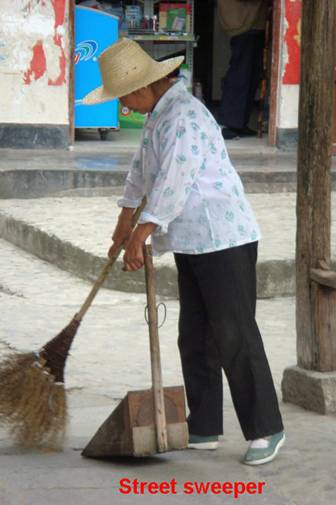
guzzling just upstream. Miniscule old people in threadbare jackets cleaning the
streets; the block-after-block scrape of straw brooms on dusty cobblestones
made the simple bravery of their endurance inescapable. And the society’s deep
contradictions obvious.
For its grand finale,
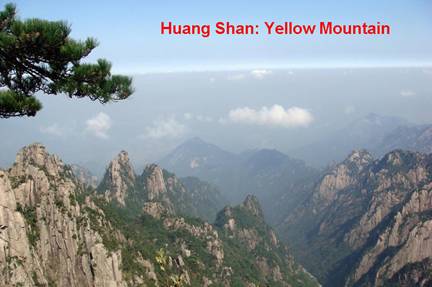
China threw at us Huang Shan--the Yellow Mountain--which was, in fact not one
but 72 separate peaks rolled into one fabulous attraction. Vans and buses
maneuver the switchback road up to 2000 feet. A cable car sends people up
another 2400 feet or so, amid stark granite peaks, dark evergreens, blue sky
and puffy clouds.
The site took our breath
away—literally--because from here we had to climb two kilometers--up and down,
down and up--a series of hills to reach the hotel. From every vantage point spectacular views.
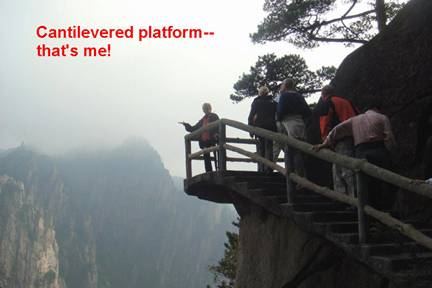
Apparently, 30 miles of
stone stairs—our guide said 500,000 steps in all—were hacked into the various
peaks, accented by concrete handrails shaped like tree limbs. The mountains,
some as high as 6000 feet, and the scenery were miraculous enough—the subject
of countless Chinese scrolls of tall peaks encased in mist. But most
unbelievable were the hotels--their very existence amid these cliffs. None of
the 6 hotel sites could be reached by mechanical conveyance.
Every building stone,
board of wood, concrete block, window, bed, dresser, bathtub, drinking glass,
dish, oven, bottle of wine had to be carried up the mountain on the shoulders
of Chinese bearers. Even today they haul propane tanks, guest suitcases,
bedding and any tourist necessity or frill, carrying them on both ends of long
poles slung across their shoulders. From the very bottom of the mountain.
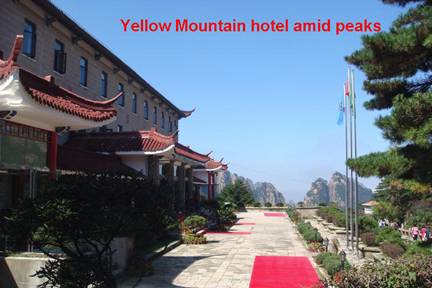
If you prefer not to walk
from the cable car you can hire a sedan chair borne on the shoulders of two
wiry men who are sweating in almost any weather. The carriers are not allowed
on the cable car. Those too are for the tourists and would take away from the
government’s take.
I alternated between
wanting to cheer them on in a kind of perverse admiration and dreading any
possible eye contact, feeling utterly embarrassed at anyone having to do such
appallingly inhumane work.
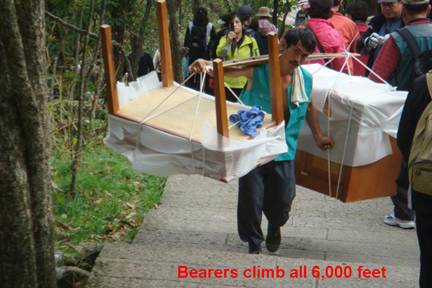
These are clearly the
parts China is not getting right.